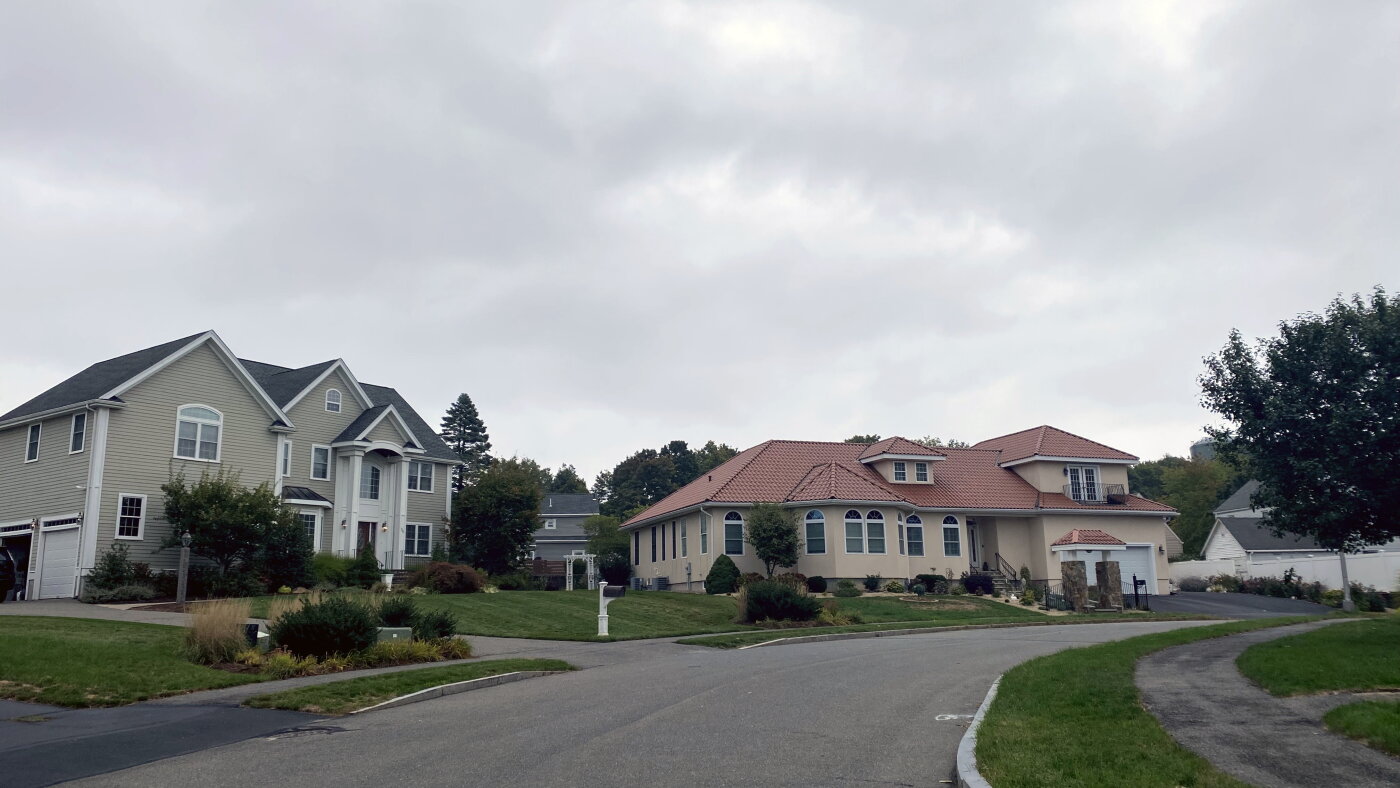

In North Braintree, Mass., larger lot sizes imposed decades ago have meant fewer homes, and bigger more expensive ones. Voters will decide whether to force cities to allow smaller homes on smaller lots.
Jennifer Ludden/NPR
hide caption
Jennifer Ludden/NPR
LEXINGTON, Mass. — Massachusetts is one of the most expensive states in the country, and it’s easy to find people frustrated with high home prices.
“It’s really hard to find housing, it’s extremely expensive, and I can’t afford to live alone,” said renter Jamie Sharken, 34, as she walks her dog in Lexington, north of Boston and near where she shares a home with three others. “There’s four of us in two bathrooms, definitely a run-down old house.”
A massive housing shortage has pushed up prices. Sharken grew up in the state and would love to buy a home, but finds it hard to see how she could afford it. She’s not alone. “Most of my friends have so much debt from education,” she said. “Just being able to save money to put a down payment on a house feels impossible these days.”
She’s heard about the ballot measure that aims to make housing more affordable by creating more starter homes on smaller lots.

Jamie Sharken, 34, grew up in Massachusetts but doubts she’ll ever be able to afford a house there. She supports a ballot measure that aims to create smaller starter homes.
Jennifer Ludden/NPR
hide caption
Jennifer Ludden/NPR
Cities and towns here and across the U.S. have set minimum lot sizes for single-family homes, many of them quite large. The measure would require them to allow homes on lots as small as 5,000 square feet, about the size of a basketball court. If it passes, Massachusetts would become the latest in a growing number of states to mandate such a zoning change amid a nationwide housing crunch.
The idea is to boost overall supply and override persistent, local “not in my backyard” opposition to new development. Critics bristle at the loss of local control and say the measure may not really help struggling first-time buyers.
But Sharken said encouraging smaller homes makes sense to her.
“There’s so many homes that are empty with five, six, 10 bedrooms and one couple living there,” she said. “I think it’s time to share the wealth in terms of the space that we have and to have more housing for people.”
An “existential crisis” generations in the making
To understand what’s driving the zoning measure and how it would work, it helps to go back in time. Andrew Mikula, a housing economist leading the push for the ballot measure, takes me to a quiet street in North Braintree, about 10 miles south of Boston.
The block we stand on was built a century ago. Colonial and Cape Cod-style clapboard homes, with shutters and dormer windows, sit fairly close together. Some are about 1,000 square feet, with three bedrooms and 1.5 bathrooms. But this is a snapshot in time.
“With modern zoning, these homes are illegal to build today,” Mikula said.
That’s because after World War II, as suburbs exploded, cities across the country mandated bigger and bigger lot sizes for single-family homes only. The trend effectively banned apartments, duplexes or townhomes on large swaths of residential land and locked in economic and racial segregation. We see the change as we walk a couple of blocks down the street.

Andrew Mikula is a housing economist leading the push for smaller lot sizes. He stands on an older block in North Braintree, Mass., with smaller lots that would be illegal for new homes today.
Jennifer Ludden/NPR
hide caption
Jennifer Ludden/NPR
Suddenly, the yards are a lot bigger and so are the houses, with stylish arched windows and two-car garages. “You need to build a large McMansion just to justify the cost of assembling so much land,” said Mikula. “So this is what you get.”
In fact, most single-family zoning in the state requires at least an acre of land — about 40,000 square feet, or nearly the size of a football field without the end zones. That also means fewer homes get built. The ballot measure does not apply to Boston, which has its own zoning rules.

By the state’s own data, expensive housing is fueling an exodus of working-age people. “And when we lose young workers and family members of people who already live here,” Mikula said, “that not only separates extended families but also hurts our economy.”
Retail, service, and healthcare workers who stay “just can’t afford to live in the communities that they serve,” said Jesse Kanson-Benanav, executive director at Abundant Housing Massachusetts.
He called the state’s housing shortage “an existential crisis” that hits all generations. An estimated 400,000 young adults still live with their parents. Meanwhile, he said seniors struggle to maintain aging homes, “because we haven’t built … moderate-sized and reasonably priced homes for them to downsize in their own community.”
In recent years, Massachusetts lawmakers have forced cities to allow multifamily housing near transit stations and accessory dwelling units wherever single-family homes are allowed, and committed billions toward public and lower-income housing. Kanson-Benanav called the starter home ballot measure “one strategy among many” and hopes that if it passes, it will inspire lawmakers to do even more. Polling suggests broad support.
Even smaller homes can be pricey
Critics resent the prospect of a blanket state mandate and question whether it will produce truly affordable housing. To illustrate that concern, Lexington Select Board member Jill Hai took me to the backyard of a yellow clapboard two-story home with windows trimmed in red.
“We’re looking at a beautiful home, I have to say,” she said. “It’s got beautiful hydrangeas.”
This smallish lot is exactly what the ballot measure would allow, because the house was built in 1900. But it’s been gut-renovated and expanded, and was on the market for nearly $1.3 million. “By the way, that is less than the median home value in Lexington, so it’s a great deal!” Hai said with a laugh.
But it’s hardly what most would consider a starter home. Just up the street, an even bigger new house on a small lot sold last year for more than $2 million.

Adam Chapdelaine, with the Massachusetts Municipal Association, and Lexington Select Board member Jill Hai question how affordable smaller-lot homes would be and worry that a surge in new homes could strain local infrastructure.
Jennifer Ludden/NPR
hide caption
Jennifer Ludden/NPR
In the current market, at least in this affluent town, Hai didn’t think the zoning change would be nearly as effective as other things Lexington has done, like creating rentals tied to people’s income and using town-owned land to build affordable housing. She said local leaders know better what’s needed — and she understands the housing crisis.
“My kids are 28 and 30, and they can’t afford to come back to Lexington,” she said.

Critics also worried that an unplanned surge in housing could strain schools, roads and other infrastructure.
The ballot measure only applies to places with water and sewer access, but “it doesn’t speak to the water or sewer system capacity,” said Adam Chapdelaine, executive director of the Massachusetts Municipal Association, which opposes the measure. Some already feel the need to expand capacity or are in the middle of planning for that.
“They are terrified that if this passes, that will completely upend those plans, or make it far more expensive and have to see those costs passed on to existing ratepayers,” he said.
More states are mandating smaller lots
This year alone, lawmakers in Kansas, Maine and Idaho imposed smaller minimum lots to tackle housing costs. Texas did so last year. Most mandated even smaller sizes than Massachusetts’ 5,000-square-foot ballot measure.
“Five thousand is a good start, and in our opinion it should be lower,” said Tobias Peter, who tracks such policies at the conservative-leaning American Enterprise Institute.

He noted that zoning power has long been delegated to cities, but for years they’ve failed to produce enough housing to meet the need. Now, a growing number of states are taking back a power they’ve always had under the U.S. Constitution.
AEI has researched the impact of smaller lots on housing prices and supply, and found builders do produce more starter homes “if you allow them to build on smaller lots in areas that have lower land prices,” said Peter.
But finding that cheaper land is hard near major cities like Boston. It’s more likely in new developments farther out, Peter said, and the smaller the lots, the more affordable the price of the homes will be.

A century-old home in Lexington, Mass., sits on a smaller lot that’s since been outlawed. But after a gut renovation and expansion, it was listed for more than $1 million.
Jennifer Ludden/NPR
hide caption
Jennifer Ludden/NPR
So how much should a starter home cost? AEI defines it as less than four times a county’s median household income. For the national median, which reached a record high in 2025 at $87,460, that would mean a starter home should cost less than $350,000.
But Massachusetts’ housing shortage is so severe, Peter thought five or even six times the income made more sense. Given Massachusetts’ high average income, that could mean $500,000 or more.
Is that really a starter home? “In Massachusetts it is!” he said.
“I wouldn’t mind downsizing myself”
On a recent evening, about 30 people in a library conference room pledged allegiance to an American flag on a large screen. It was the start of a meeting of the Weymouth Democratic Town Committee to discuss this year’s election ballot measures. The organizer noted he’d heard a lot of interest in the one on zoning.
The crowd was mostly older, with many homeowners, but opinions were mixed.
“I understand the problem. But I think they need to work a little harder to find a better solution,” said Kathy Swain, who’s lived in Weymouth all of her 70-plus years. She’s very involved with local politics and does not like the idea of a state mandate.
“I just think that people in local communities need to have local authority, otherwise they’re going to become more disengaged than they already are,” she said.

A few feet away, Susan Donovan said she might be in favor of the measure, “because I wouldn’t mind downsizing myself.” Expensive housing makes that hard, too.
Donovan has been thinking about building a smaller place on her property and having the children move into the big house. “We don’t need all the big land anymore,” she said. “We don’t want to mow it anymore, right? Small sounds good to me.”